Here's a handful of my astrophotographs.
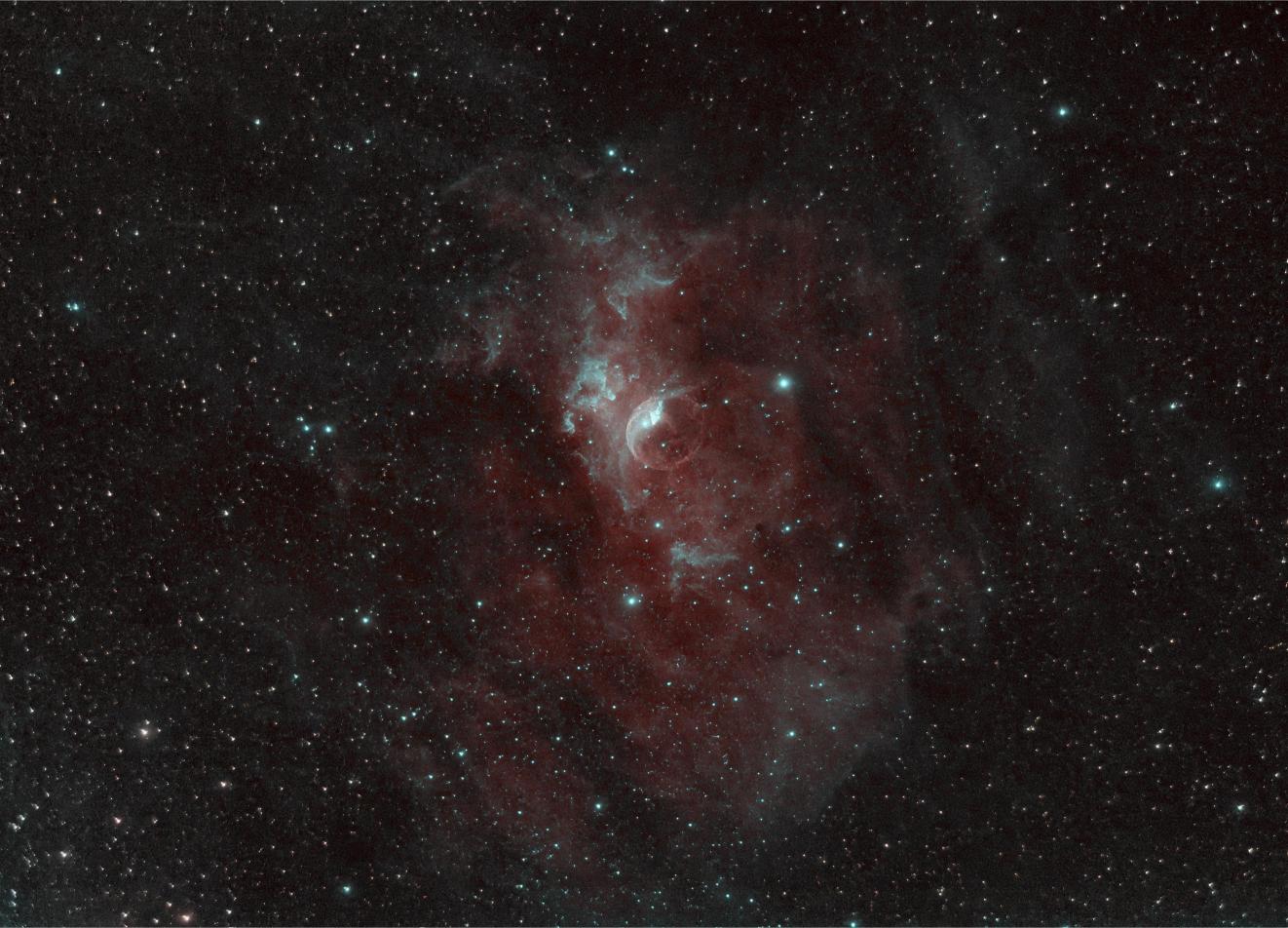
NGC 7635, also known as the Bubble Nebula, Sharpless 162, or Caldwell 11, is an emission nebula in the constellation Cassiopeia. The nebula is about 8,000 light years from Earth.
It was nicknamed the Bubble Nebula because of its shape, which was created by a strong stellar wind from a young, massive, hot Wolf-Rayet star that shed its material to form the nebula. The round bubble in the nebula is about 10 light years in diameter.
The central star is the bright object inside the bubble towards the upper left. It’s off-center because the gas expanding to the left slams into the dense nebula and slows down. Massing 44 times that of the sun, the star is also much hotter: 37,000˚K versus 5,700˚K. The Stefan-Boltzmann Law says luminosity is proportional to the fourth power of the temperature, and indeed this star shines 400,000 times brighter than the sun. Being massive, it will have a short life, ending in a type Ib supernova.
The Bubble Nebula was created about 300,000 years ago, when the central star expelled a shell of dust and gas. Ferocious stellar winds ionize the bubble and give it its distinctive shape.
This was a challenging target as it is faint, which meant 26 hours of exposure. I process all my images using a program called Pixinsight, which lets me reject some frames, integrate the rest into a single picture, and do scores of mathematical operations to reduce noise, enhance contrast, and the like. This image consumed most of a week of work to reduce the raw data to the picture you see.
Date imaged: December 2022 (over 7 nights)
Location: Our backyard in Finksburg, MD
Telescope: Celestron 8 with 6.3 focal reducer for a 1260mm focal length
Filters: Hα, SII, OIII. These are mapped Hα -> R, SII -> G, (SII + OIII *0.27) -> B
Camera: ASI2600MM mono, cooled to -10C
Images: 3124 images, each 30 seconds. Total of 26 hours of exposure
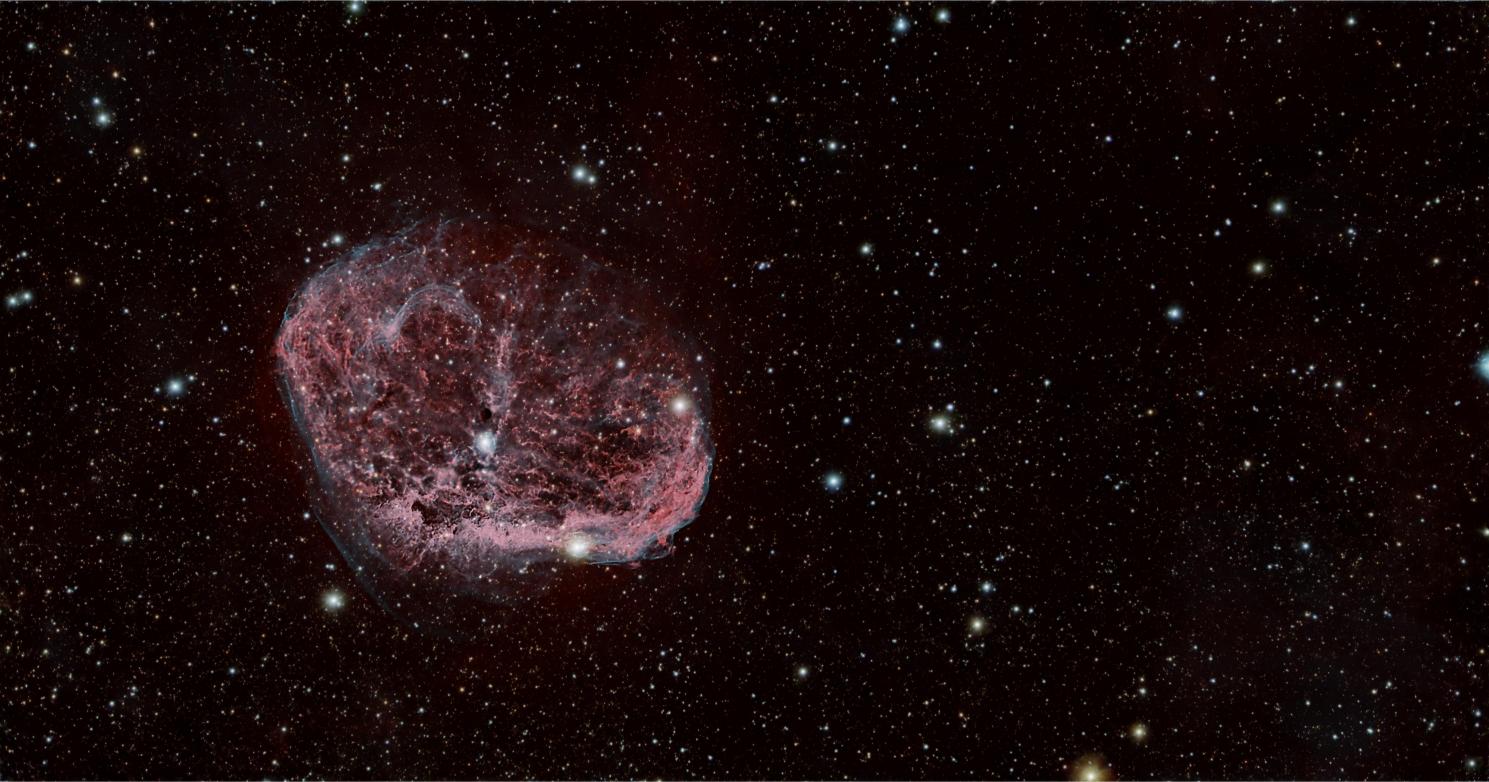
NGC6888 is an emission nebula in the constellation Cygnus. About 5000 light years away from us, it is pretty dim.
The nebula is formed from the wind from the bright star near the nebula’s center. This is a Wolf-Rayet star (WR 136), one of the brightest classes of stars; this one has the mass of ten of our suns and 60,000 times its luminosity. That wind collides with clouds of ionized hydrogen and doubly-ionized oxygen. These in turn emit visible light at 656 and 501 nanometers, respectively, as well as UV and IR wavelengths. These clouds were ejected by WR 136 about a quarter-million years ago. The stellar winds are racing through the nebula at 3 million miles per hour.
It’s thought the star will explode as a supernova in about 100,000 years. The nebula is 25 light years across.
Why “Crescent Nebula”? I don’t see a crescent shape. It seems the poor telescopes of the early 19th century couldn’t really resolve most of the features, and observers thought they saw that shape.
Date imaged: 5 nights in September and October, 2024
Location: Bear Branch Nature Center, Westminster, MD
Telescope: Celestron 8 with 6.3 focal reducer for a 1260mm focal length
Filters: RGB, Ha, OIII
Camera: ASI2600MM mono, cooled to -10C
Images: 1976 images, each 30 seconds. Total of 16.5 hours of exposure
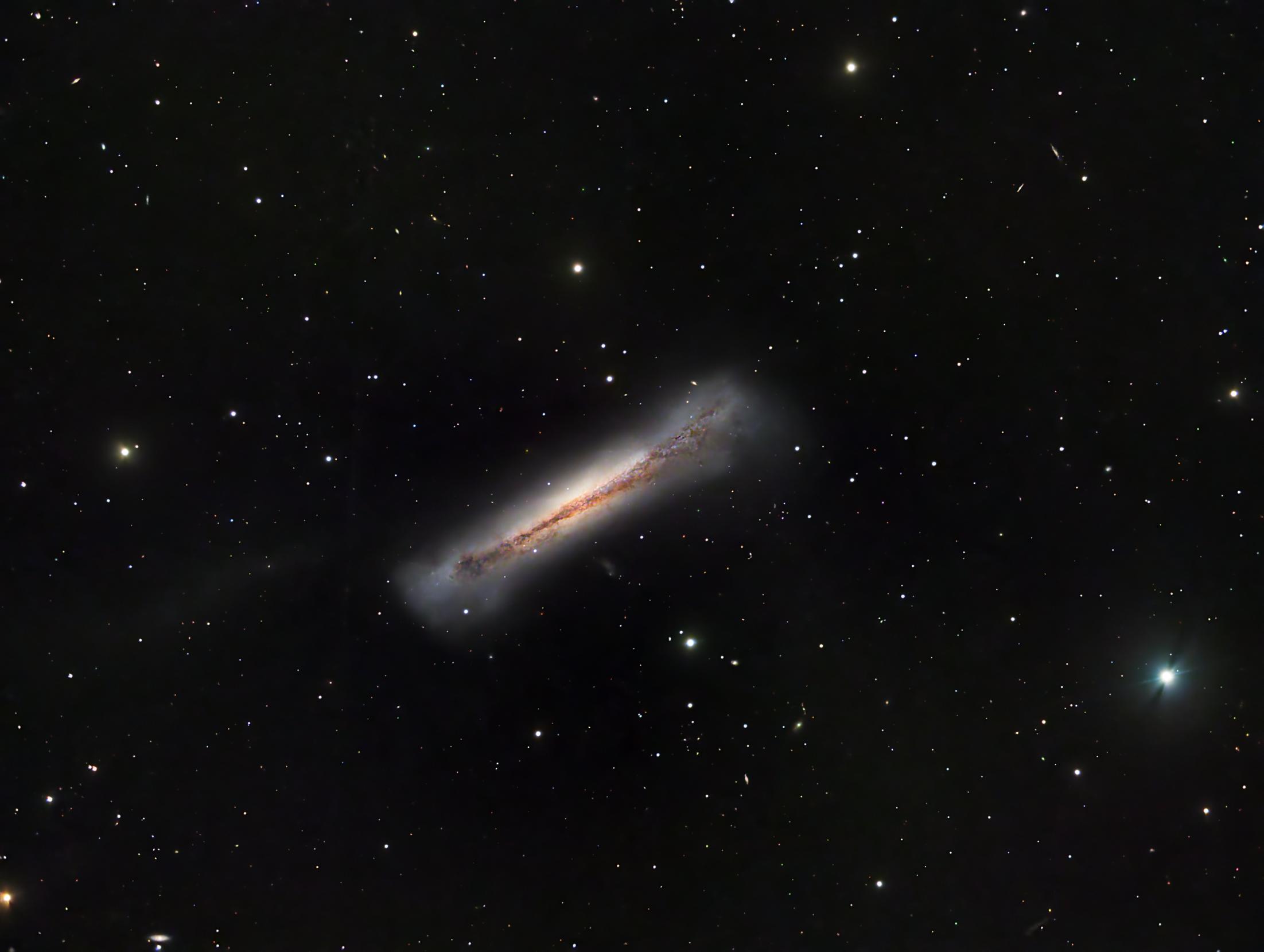
NGC 3628, also known as the Hamburger Galaxy or Sarah's Galaxy, is a spiral galaxy about 35 million light-years away in the constellation Leo. Its 13.1 arcminute width gives it a diameter of about 133,000 light years, mirroring our Milky Way.
Barely visible is a 300,000 light-year-long tidal tail extending from the left and up. This is a stream of stars. That, plus the twisted dark dust lanes suggest that it is interacting with M65 and M66 (not shown in this image). Those two galaxies, plus this one, form the well-known Leo Triplet.
Gas orbits in the opposite direction from the stars, indicating a relatively recent merger with another galaxy.
A couple of red spots are visible; these are globular clusters.
A 2002 paper (NGC 3628: Ejection Activity Associated with Quasars, H. Arp et al) found several quasars near this galaxy that have been ejected from it, apparently propelled by high-energy X-rays. Normally quasars are found at very distant parts of the universe. One of these has an astonishing red shift of 2.15; a little fiddling with the math shows that object has been ejected at 82% of the speed of light!
Date imaged: March 2023
Location: Our backyard in Finksburg, MD
Telescope: Celestron 8 with 6.3 focal reducer for a 1260mm focal length
Filters: LRGB
Camera: ASI2600MM mono, cooled to -10C
Images: 288 images, each 120 seconds. Total 9.6 hours of exposure
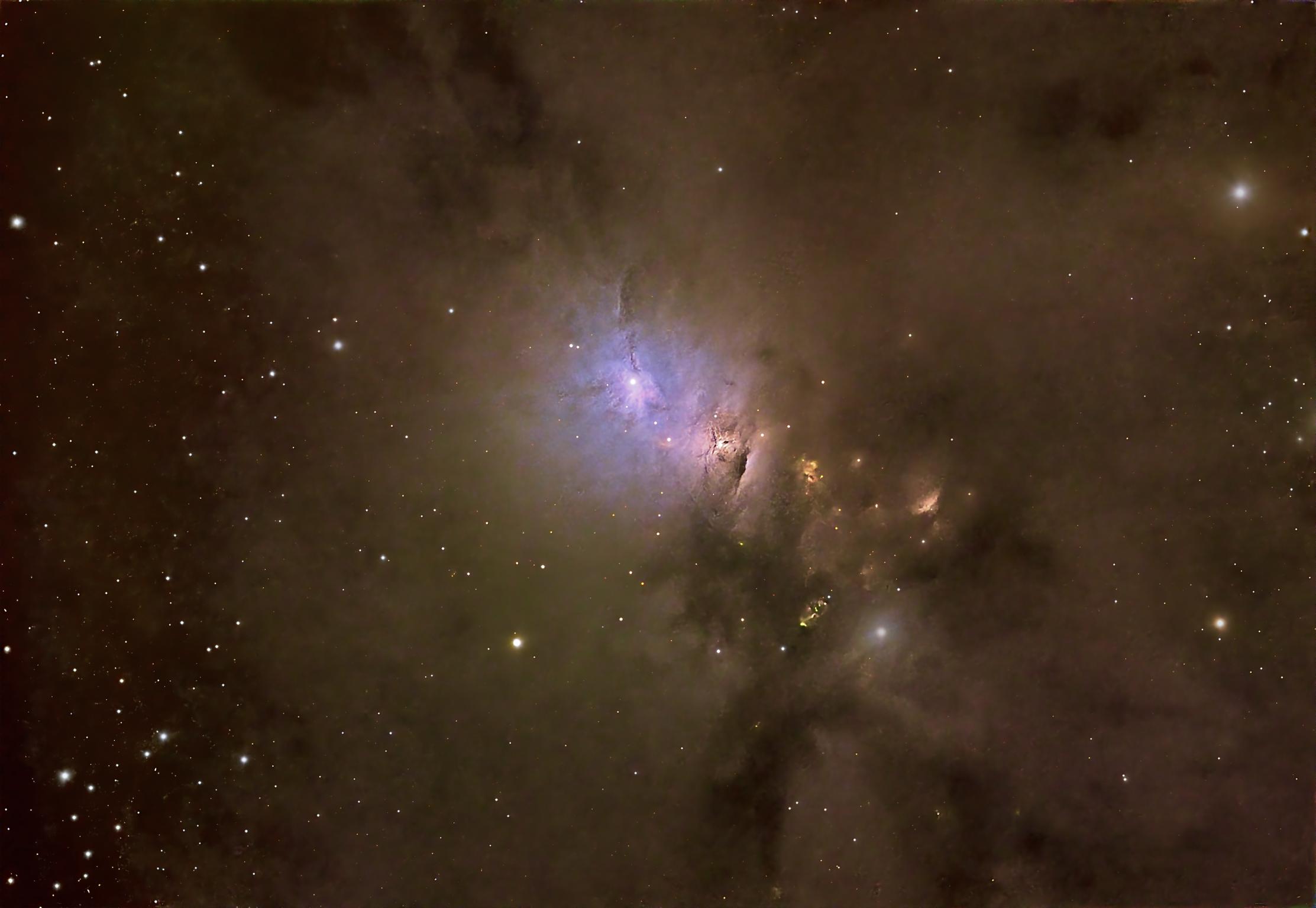
NGC1333 is a reflection nebula in the constellation Perseus. About 1000 light years away, it is a region of active star formation. Some 150 stars, massing a total of 100 of our suns, are present. They’re young, on the order of a million years old. Many are not yet on the main sequence. Some are tiny with spectral type M9 or L0. Those have the mass of around ten Jupiters, and are more planets than stars. Called “planetary-mass objects” they are smaller than even brown dwarfs, and cannot sustain fusion.
Others are big and bright of spectral class OB. These won’t last long, likely going supernova and seeding the clouds with heavy elements.
The very bright star near the center is expelling extreme stellar winds, which light up the dust around it. It’s blue, as the wavelength of Raleigh scattering is inversely proportional to wavelength raised to the fourth power.
Complex organic molecules have been found near this object; these, of course, are the basis for life.
This image captures the nebula itself (the bright region), as well as the dark nebulae Barnard 1 and Barnard 2.
I imaged this with the normal red, green, blue and luminosity filters, as well as the Ha, OIII and SII. My hope was to capture the dark nebula with the LRGB, and star-forming regions with the narrowband filters.
Date imaged: 6 nights from November 2023 to January 2024
Location: Our backyard in Finksburg
Telescope: Celestron 8 with 6.3 focal reducer for a 1260mm focal length
Filters: L, R, G, B, Ha, OIII, SII
Camera: ASI2600MM mono, cooled to -10C
Images: 3575 images, each 30 seconds. Total of 29.8 hours of exposure
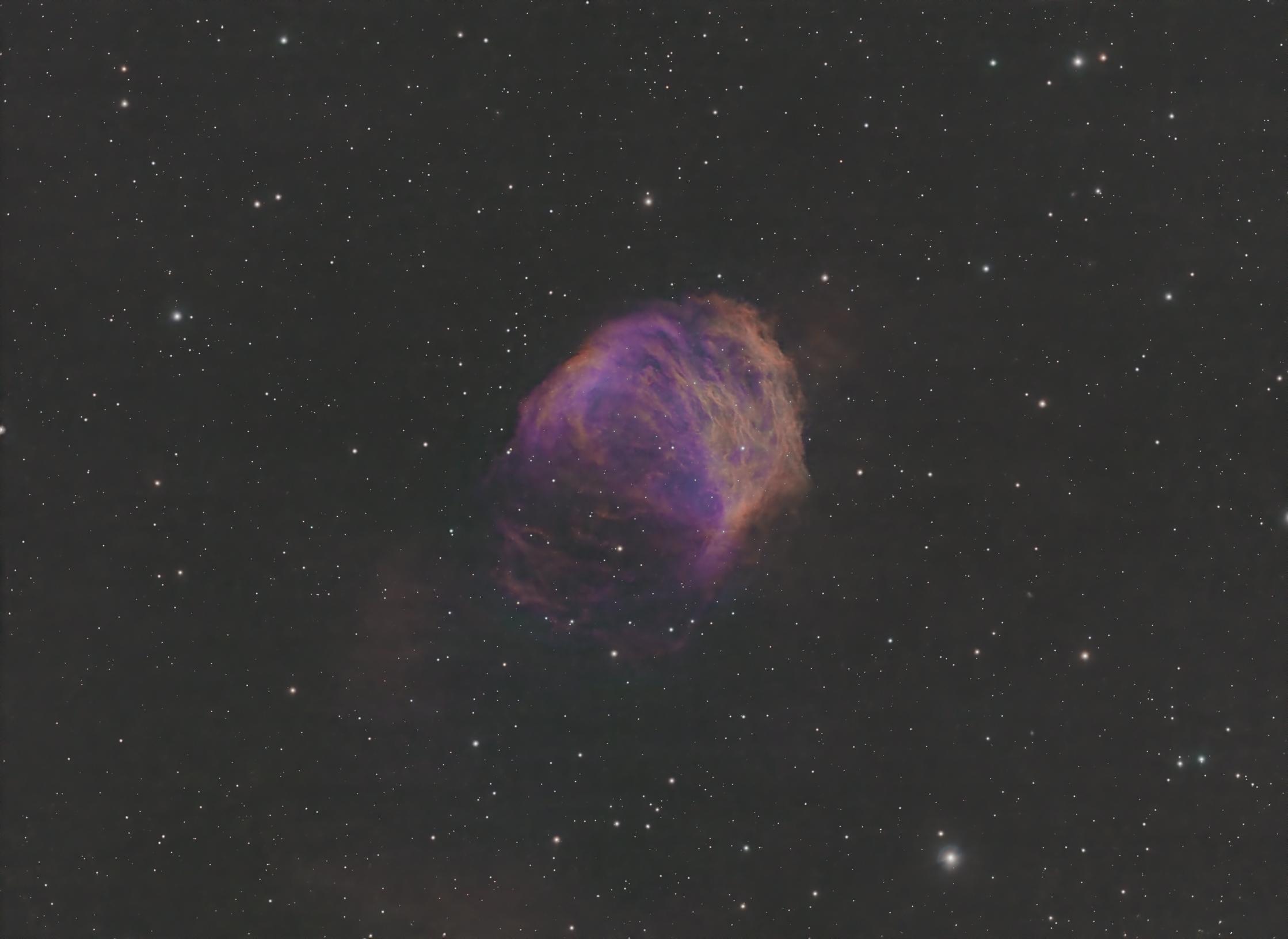
The Medusa Nebula is a very dim planetary nebula in the constellation Gemini. At magnitude 16 it is faint indeed. George Abell discovered it in 1955 and gave it the name Abell 21. About 1500 light years away, it is 4 light years across.
The central star blew off its outer layers and is now transitioning from a red giant to a white dwarf. It’s called a pre-degenerate star as it will, when it becomes a white dwarf, be a degenerate star, supported by electron degeneracy pressure. And it will hardly be a star, as white dwarfs no longer fuse. They are very hot and cool slowly, over trillions of years, ending up as dead cinders known as black dwarfs. It’s thought that the universe is too young for any white dwarves to have cooled to this state.
The star ejected the nebulosity about 6800 years ago.
It was long thought to be a supernova remnant, but a Soviet astronomer in 1971 measured the nebula’s expansion and found it to be only 50 km/s, too slow for anything but a planetary nebula. It will totally disperse in a few thousand years.
Date imaged: December 2023 and January 2024
Location: Our backyard in Finksburg, MD
Telescope: Celestron 8 with 6.3 focal reducer for a 1260mm focal length
Filters: OIII, SII, Hα
Camera: ASI2600MM mono, cooled to -10C
Images: 1423 images, each 30 seconds. Total 11.9 hours of exposure
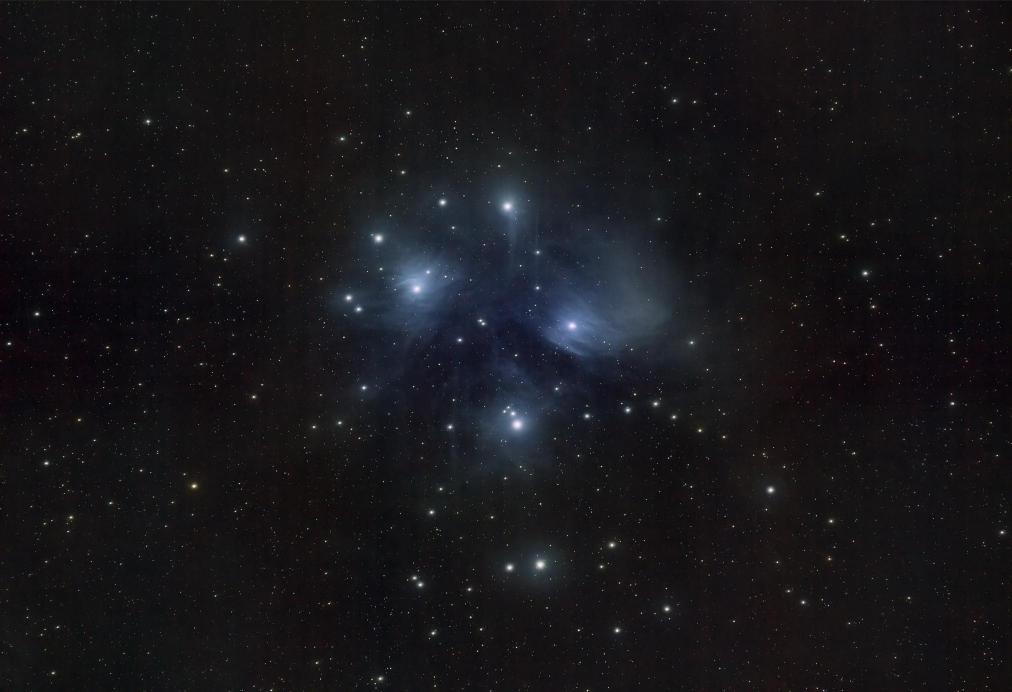
M45, AKA The Pleiades, AKA The Seven Sisters, is an open star cluster in the constellation Taurus. 440 light years away, it is one of the closest open clusters to Earth and is the most obvious one to the naked eye. (The nearest is the Hyades, also in Taurus, and while not as bright as M45, is also easily seen).
The Pleiades is known by many names in different cultures. In Japan it is called Subaru; the car is named after this cluster, though, oddly, the emblem on Subaru cars only has six stars.
Despite the moniker, the cluster has far more than seven stars. Even Galileo with his primitive telescopes identified 36. We now know that the Pleiades has over 1000 associated stars; over half are binary pairs.
M45 is about 100 million years old, and contains many bright B-class stars, which explains their blue coloring. B-class stars are big (Alcyone, the brightest in this cluster, is 20 times the size of the sun and 6 times as massive), and hot. Alcyone is 2030 times as bright as our sun, though will live a much, much shorter life as it furiously consumes its nuclear fuel.
The nebulosity around the stars is a reflection nebula, where the light of the stars is bouncing off dust particles. It’s thought that this dust is just cosmic debris that the cluster is passing though as it moves towards Orion.
I used short, five-second exposures as the stars are so bright longer images would have saturated the camera’s sensor.
Date imaged: November 2023
Location: Our backyard in Finksburg, MD
Telescope: AT72EDII with a 0.8 reducer/flattener for a 334mm focal length
Filters: n/a
Camera: Canon 70D color camera
Images: 3775 images, 5 second exposures. Total of 5.2 hours of exposure
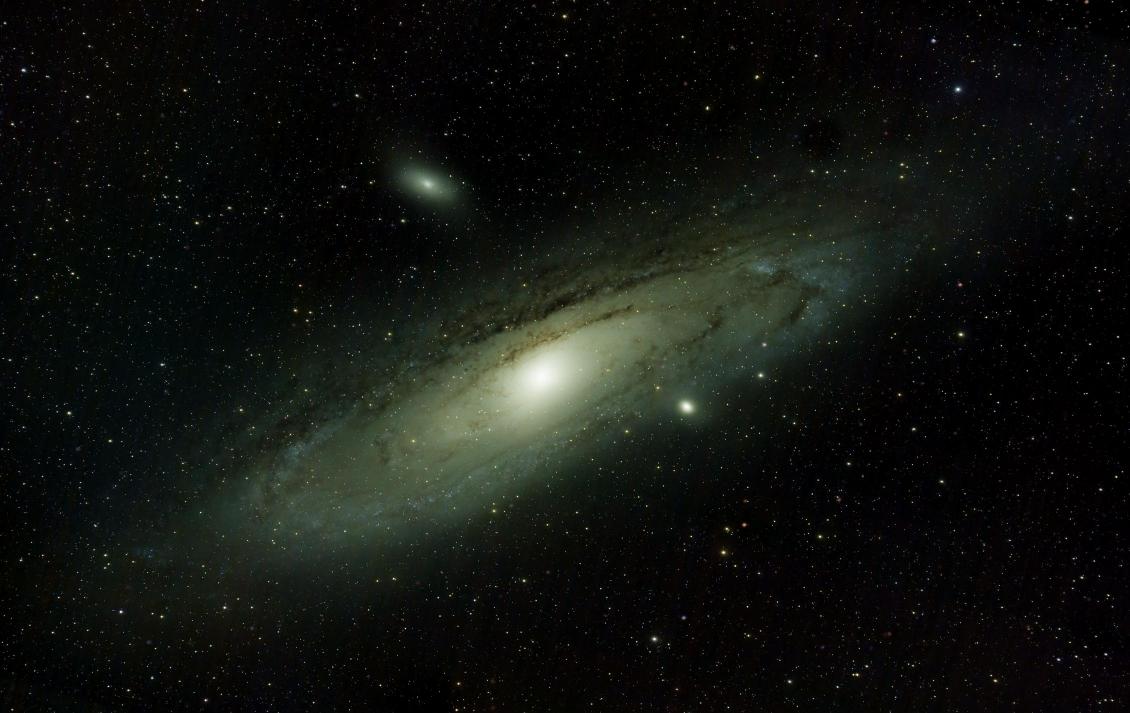
The Andromeda Galaxy is the closest spiral galaxy to the Milky Way at 2.2 million light years away. It’s very large, some 152,000 light years across, and massive: about that of a trillion of our suns.
It’s the only galaxy, other than ours, visible to the naked eye from our latitude. On a dark night it looks like a faint smudge. (Some people can see M81 and M33, but perfect conditions and young eyes are needed).
Andromeda’s destiny is tied in with the Milky Way’s, as both will collide in about 5 billion years. Both will lose their spiral structure and become egg-shaped ellipticals.
William Parsons, the 3rd Earl of Rosse, was an 18th-century Irish astronomer who built the enormous 72 inch “Leviathan of Parsonstown” telescope. With that instrument he made a sketch of Andromeda’s spiral morphology, which was also the first-ever drawing of a spiral galaxy.
Andromeda played a pivotal role in our understanding of the universe. It was long thought that the Milky Way comprised the entire universe, and the various nebula were just gas clouds. In 1755 philosopher Immanuel Kant, of all people, proposed that Andromeda was a galaxy distinct from ours, though his idea got little traction. The Great Debate in 1920 between Heber Curtis and Harlow Shapley about this failed to resolve the issue (though Shapley seemed more interested in impressing the Harvard faculty in the room to get a job there – which he did – than in presenting evidence). But Edwin Hubble settled the matter in 1925 when he was able to measure the distance to Andromeda by observing Cepheid variable stars. His estimate was low by a factor of two, but still large enough to settle the matter.
Perched above M31 is NGC205 (aka M110); below, M32. Both are small elliptical galaxies that interact with their larger neighbor, distorting its spiral arms. About 20 small galaxies orbit Andromeda.
The galaxy is nearly three degrees across, so is much too large for my 8” telescope. I imaged it with my small 72mm scope.
Date imaged: October 2023
Location: Krimgold Park and Bear Branch Nature Center, Carroll County, MD
Telescope: AT72EDII with a 0.8 reducer/flattener for a 334mm focal length
Filters: n/a
Camera: Canon 70D color camera
Images: 1129 images, 30 second exposures. Total of 9.5 hours of exposure
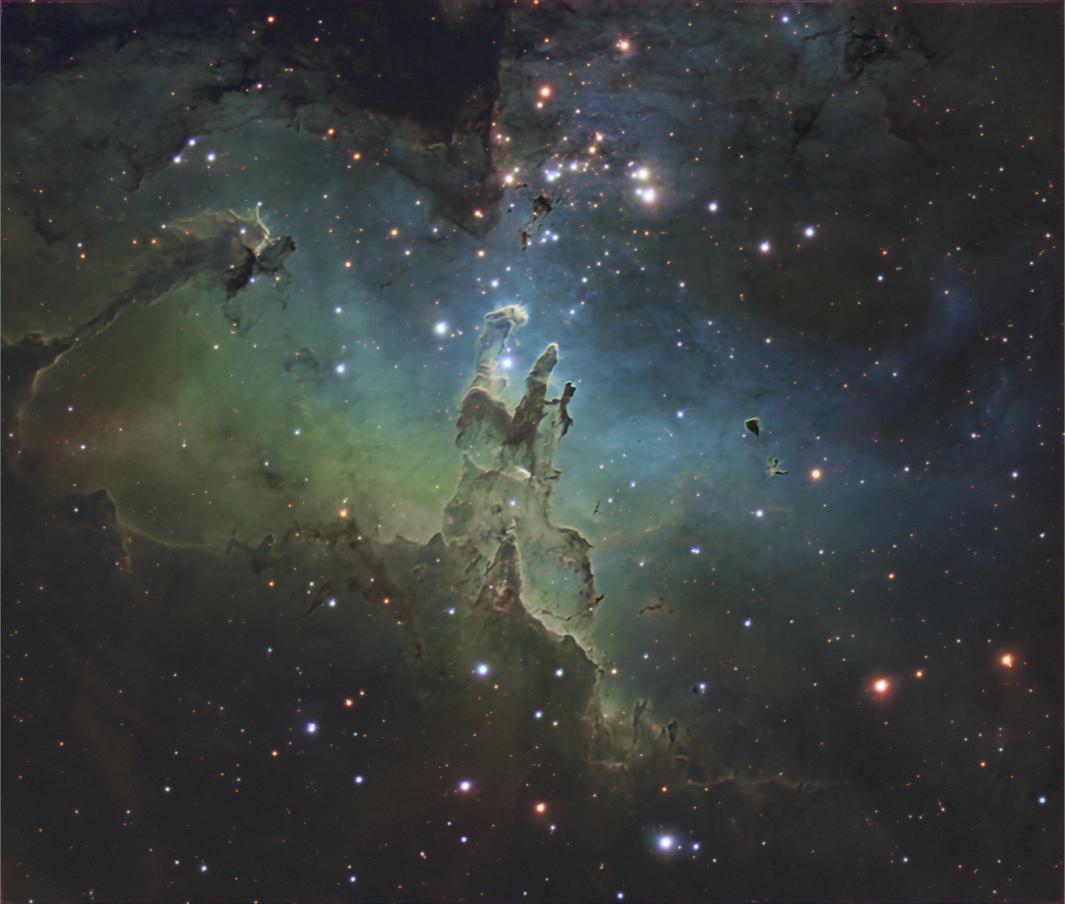
M16 is an open cluster and emission nebula in the constellation Serpens. It’s about 5700 light years away from us and is only around one million years old. About 8500 stars are in the nebula.
The “Pillars of Creation” (in the center of the image) were made famous by the Hubble Space Telescope. These are active star-forming regions. The pillars are clouds of hydrogen and dust that hide star formation. The James Webb Space Telescope has managed to peer inside these in the IR to show some of these protostars. The pillars are given much of their shape by erosion from the UV light from nearby hot stars. They are around 4 light years long.
The longer pillar points to two bright stars; the lower is a pair of O-class stars. The larger is 80 times as massive as our sun and shines a million times brighter.
Date imaged: August, 2024
Location: Bear Branch Nature Center, Westminster, MD
Telescope: Celestron 8 with 6.3 focal reducer for a 1260mm focal length
Filters: RGB (one hour total exposure for star colors), Ha, OIII, SII
Camera: ASI2600MM mono, cooled to -10C
Images: 1470 images, each 30 seconds. Total of 12.7 hours of exposure
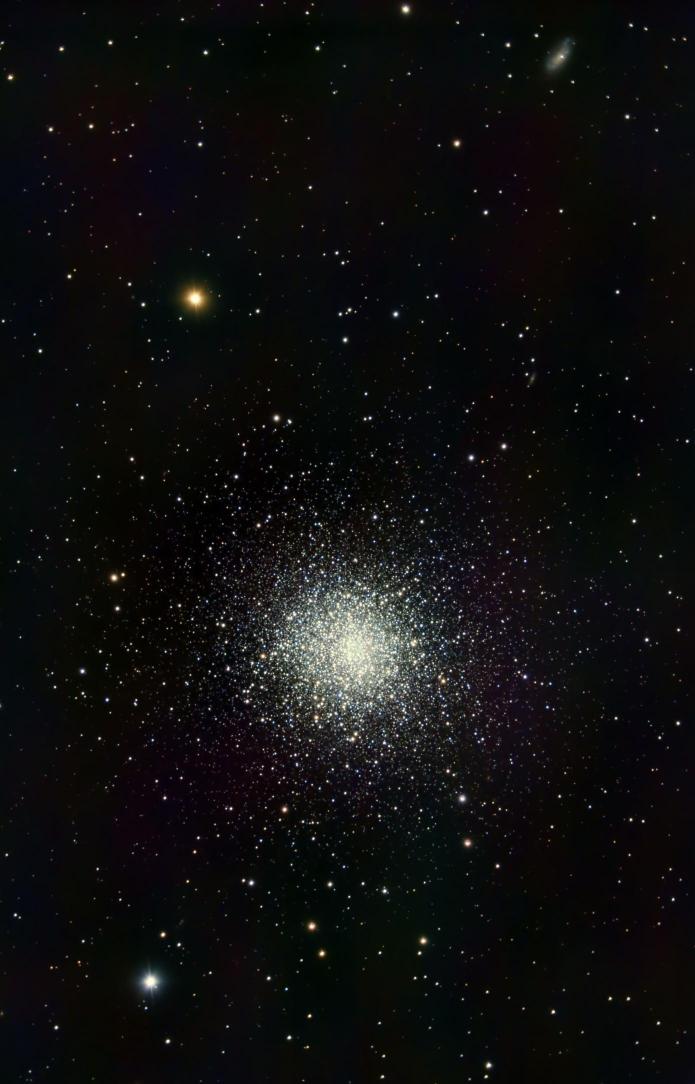
M13 in Hercules is the nicest globular cluster in the northern skies. It is very bright, and one with good vision in dark skies could just make it out with no optical aids.
M13 is 22,000 light years away from us, well above the galactic plane. It is about 145 light years in diameter and is comprised of around a half-million stars. It rotates in a retrograde orbit around the Milky Way, suggesting it was captured from another galaxy.
Globular clusters are spherical groupings of many stars. They are typically halo objects around galaxies. The stars are very old, often around 10 billion years. Old stars are formed from the components of the early universe, before supernovas had a chance to seed space with heavy elements. So globular stars are almost entirely composed of hydrogen and helium. These are “population II” stars; those formed from the remnants of the very first – population III – stars. None of those are known to still exist.
About 150 globulars are known to be associated with the Milky Way, though there could be many more. The Andromeda galaxy, which is very much like our own, has over 500. M87, a giant elliptical 50 million light years away, has over 13,000.
While looking very dense, even at M13’s core stars are about a third of a light year apart. They have little gas or dust, all of that having been converted into stars.
It is thought that there is a black hole at the center of this cluster.
Most M13 images are overexposed; to prevent this I used over a thousand two-second shots.
Date imaged: May 2022
Location: Our backyard in Finksburg, MD
Telescope: Celestron 8 with 6.3 focal reducer for a 1260mm focal length
Filters: n/a
Camera: Canon 70D DSLR
Images: 1130 images, each 2 seconds. Total 38 minutes of exposure
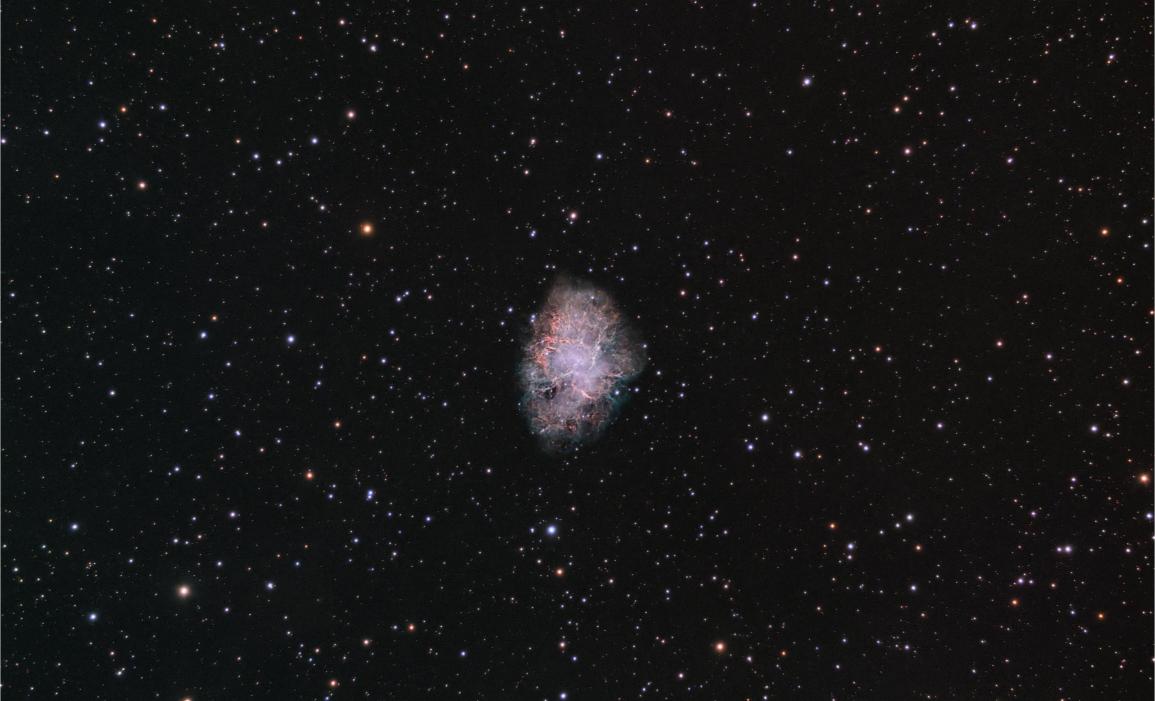
In the year 1054 a new star appeared, so bright it was visible in the daytime. Chinese astronomers recorded that it could be seen for 23 days when the sun was up and about two years at night. It was a supernova: a star exploding in the constellation Taurus. A supernova is one of the most violent things in the universe.
A thousand years have gone by and all that’s left is the Crab Nebula, aka M1. About 6,500 light years from Earth, it has a diameter of 11 light years. When the star went supernova it collapsed in a matter of seconds generating as much light as many billions of stars. The nebula is the part of the star that was blown apart. It’s still expanding at 1,500 km per second.
The universe was composed of hydrogen, helium, and tiny amounts of lithium when it first formed. Fusion in stars produced elements like carbon, oxygen, neon, silicon and iron. Exploding supernovas formed the rest. As Joanie Mitchell wrote “we are stardust”.
Not visible in the image is the neutron star left behind after the terrific explosion. Weighing as much as twice our sun, it’s the size of a city. And dense! A teaspoon of its material would weigh over a billion tons. Its gravitational field is intense, but it is prevented from further collapse by neutron degeneracy pressure, a quirk of the Pauli Exclusion Principle. Spinning at 30 revolutions per second it emits powerful radio waves, X-rays and gamma rays. It’s generally the brightest source in the sky of the latter two high-energy sources.
The Crab Nebula is also called M1, being the very first entry in Charles Messier’s eponymous 18th century catalog. He was a French comet hunter who often mistook objects in the sky, like M1, for comets, so compiled a list of comet-like things to avoid. That eventually swelled to 110 objects. Ironically, today these are considered some of the best things to observe.
The nebula’s luminosity across all wavelengths is about 100,000 times brighter than our sun.
Date imaged: December and January 2022-23
Location: Our backyard in Finksburg, MD
Telescope: Celestron 8 with 6.3 focal reducer for a 1260mm focal length
Filters: LRGB
Camera: ASI2600MM mono, cooled to -10C
Images: 1125 images, each 30 seconds. Total of 9.4 hours of exposure
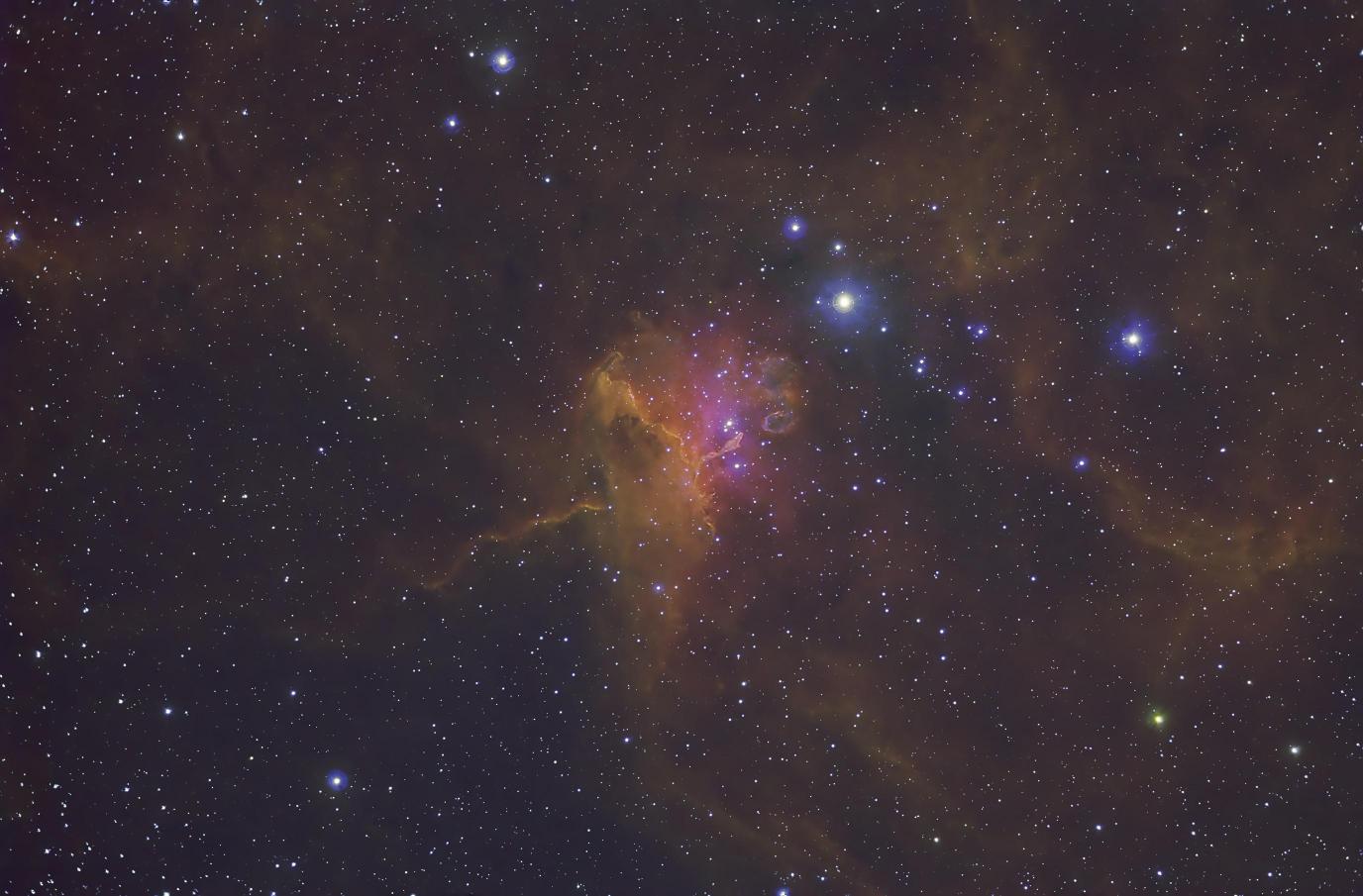
Located in the constellation of Auriga, IC417, or the Spider Nebula, is an emission nebula about 7,100 light years from Earth. It is a hotbed of new star formation.
The nebula is quite young at less than 3 million years old. There are over 500 “Young Stellar Objects” in this nebula; these are stars that are just forming, ranging from 100,000 to a few million years old. Some are protostars: condensed gas clouds still forming. As these only radiate at long wavelengths they are not visible. Others are pre-main-sequence stars – they’re generally not burning hydrogen. Most of their energy is from gravitational contraction, though some (T Tauri stars) will burn lithium.
The Spider Nebula is a strong hydrogen-alpha emitter (Hα) at 656 nm, along with a somewhat weaker oxygen III (501 nm) line. Not many stars burn lithium as these T Tauri orbs do, but lithium radiates at 670.8 nm, which is within the 7-nm bandwidth of my SII (672 nm) filter.
The small rings visible near the center are called “Auriga Bubbles”. Each is about 300 light years in diameter. It’s likely these are remnants of past supernovas whose shock waves stimulated star production in the area.
Date imaged: January and February 2023
Location: Our backyard in Finksburg, MD
Telescope: Celestron 8 with 6.3 focal reducer for a 1260mm focal length
Filters: Hα, SII, OIII. These are mapped to RGB respectively
Camera: ASI2600MM mono, cooled to -10C
Images: 1871 images, each 30 seconds. Total of 15.6 hours of exposure
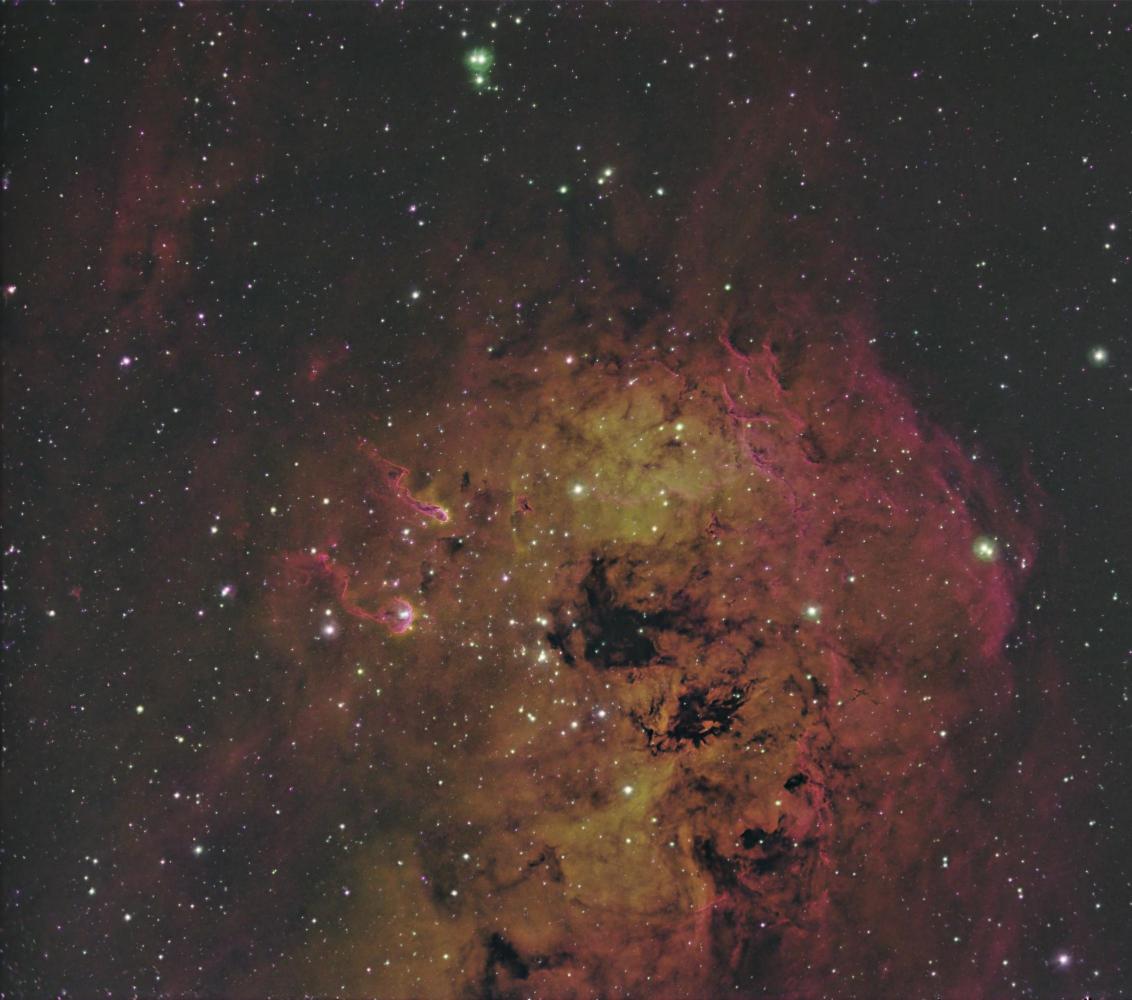
IC410 is an HII region in the constellation Auriga. An HII region is composed of (primarily) ionized hydrogen. It’s about 12,400 light years away. It is named the Tadpole Nebula due to the tadpole-shaped clouds that appear to be swimming towards the center of the nebula. These are gas globules, dense knots of gas and dust, about 10 light years across.
This image includes NGC 1893, an open star cluster between the tadpoles and the big black spot in the center of the picture. While big telescopes pick out over 4000 stars in this cluster, here you can see a few large, hot O and B type orbs that are young (around 4 million years). No O or B star lives long as they are massive and burning their fuel at a furious rate. The HII region is ionized from the energy emitted by these stars.
The tadpoles’ tails are pointing away from the star cluster due to the very strong stellar winds and radiation pressure from that cluster. Many stars are forming in the heads of the tadpoles.
Alas, IC410’s pretty gas clouds will, in a few million years, dissipate.
Date imaged: 5 nights in February, 2024
Location: Our backyard in Finksburg
Telescope: Celestron 8 with 6.3 focal reducer for a 1260mm focal length
Filters: Ha OIII SII, combined as HOS
Camera: ASI2600MM mono, cooled to -10C
Images: 1906 images, each 30 seconds. Total of 15.9 hours of exposure
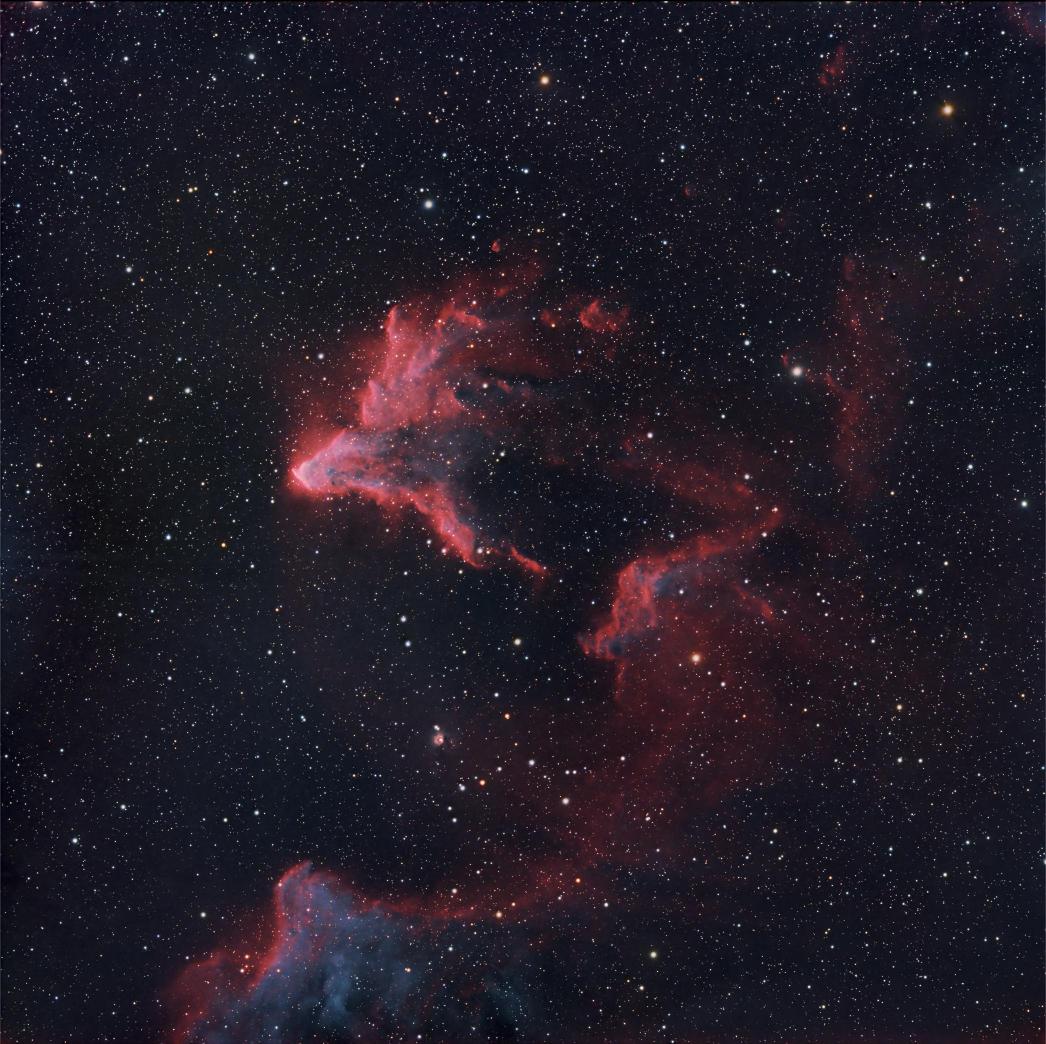
IC63, located 550 light years away in the constellation Cassiopeia, has a rather paranormal look, earning it the name “The Ghost of Cassiopeia.” This is a very faint and large object. It’s some 10 light years across. Red dominates this view as the nebula is largely hydrogen, which is being bombarded with energy from the nearby star Gamma Cassiopeiae, commonly known as Navi. This energy raises the energy level of hydrogen’s electron, which then falls and emits a photon at 656 nanometers, smack dab in the red part of the spectrum. There’s some blue coloration as well; this is Navi’s light reflected off dust in the nebula.
While IC63 is pretty, it’s also pretty ephemeral as Navi’s energy is both shaping and destroying the gas and dust. While the star is not in this image, it would be just off to the left; you can imagine how those photons are sculpting the Ghost from left to right.
Where does all of this energy come from? Navi is a blue-white giant, 19 times more massive and 65,000 times more luminous than our sun. It’s surface is a scorching 25,000 degrees K, which means most of that energy is in the ultraviolet. And, it’s likely that Navi is really a system of eight stars orbiting each other, one of the most complex systems known.
Date imaged: Four nights in November, 2024
Location: Bear Branch Nature Center, Westminster, MD
Telescope: Celestron 8 with 6.3 focal reducer for a 1260mm focal length
Filters: R, G, B, L, Ha
Camera: ASI2600MM mono, cooled to -10C
Images: 1617 images, each 30 seconds. Total of 13.5 hours of exposure